Hooky

14 May 2012 | 9 comments | Annuitants | by

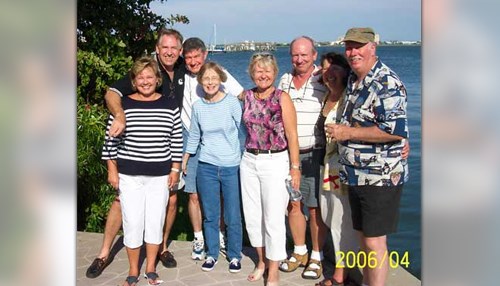
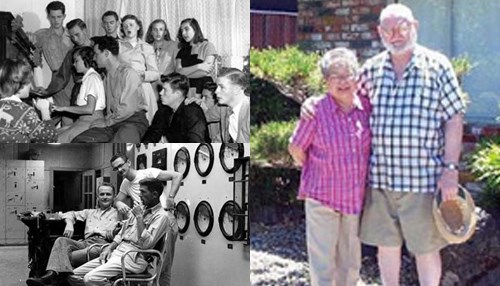
HookyAuthor, Tim Barger (standing), at age 7, David Snyder, and Mary Barger, age 3

For some unknown reason, throughout my life various circumstances have led me into unusual situations. Perhaps the drummer I was marching to played Stockhausen on the snares, but it began early in life. I was born in Dhahran in 1947 where I lived at 1134 Hamilton House, the palatial, by Dhahran standards, company guest house was on the next block to the north. It was the only place with a lawn covered hill in town. Rolling down the slope was great fun and you’d always come home with grass stained jeans, itching like mad from the bugs in the grass.

To the south was a large median with two bachelorette portables. The bachelorette portables were terrific. If you were a kid, you could go and knock on the door and almost always some lovely single woman would answer, invite you in and spoil you with cookies and maybe a Pepsi. A block further on was the recreation complex: the pool, the bowling alley, the Fiesta room – a snack bar and coffee shop, the tennis courts, the ball field, the movie theater, and unfortunately the school.

I didn’t really have anything against school, my brother and sister went there, but it did seem somewhat constricting as you had to go every day at the same time. So when I turned six it was off to the Gulag. However my family was on a short leave, so I started Kindergarten a week or so late.

At that time Kindergarten was held in a portable adjacent to the pool – it later achieved infamy as the Teen Canteen. I showed up and was amazed to find all these kids that I didn’t know running around before class. Dhahran was small, but my circle of acquaintances was even smaller. I wasn’t there long that day before I noticed the cutest girl with jet black hair cut in a page boy. The other boys noticed her too, called out her name “Stephanie,” and chased her and her friends around the play area. Of course, when she and her friends stopped, the boys froze and didn’t know what to do next. The girls would laugh and scurry off to be chased some more.

In the middle of all this confusion we heard someone yelling, “Help! Help!” from the pool area. A dozen or more of us poured through the picket fence gate to see someone that I knew, hollering helplessly, upside down in a tree. It was Jimmy R. He had been climbing a young Ficus about ten feet tall, had slipped and was suspended four feet from the ground by his ankle that had caught in the crook of a branch. He was red faced, screaming in terror and like a band of munchkins we swarmed around him with not the slightest idea of how to save him. After a minute or two, Sebastian, the big Goanese lifeguard, strode in like King Kong, grabbed Jimmy’s ankle and plucked him out of the tree like it was the simplest thing in the world. We were amazed and all crowded around Jimmy to congratulate him for his escape from an untimely death.

After the melee subsided a bit, I was talking to Jimmy when Stephanie appeared to ask if he was okay. He talked to her for a minute and then in a moment of humanity and compassion that I’ll always cherish him for, he introduced her to me. She smiled at me with dancing eyes and said, “So nice to meet you sir.” Laughed and bounded off. I didn’t know if she was joking or being sincere or what, I didn’t care. I was in heaven. Now she knew my name.

The bell rang and we all marched into class. Everyone but me seemed to know what they were supposed to do, but I bumbled along and the teacher told me that I was to bring a rug the next day for Nap Time. Looking back I can imagine that the teacher couldn’t wait every day until she could call for Nap Time.

So on my second day of Kindergarten I trooped off to school but for some reason I was late. When I got to the portable the door was closed and class had already started. I sort of panicked, if I went in now everyone would laugh at me. Not so bad, but what would Stephanie think about me? After about thirty seconds of careful deliberation and deep soul searching, I dumped my rug and fled. Thus began my descent into a life of criminality known as playing hooky.

I didn’t know where to go, so I first went to the bit of jebal that remained behind the fenced patio of the Kindergarten portable, next to the hobby shop. There was some unspoiled ground there with a gnarled acacia tree on the slope. I sat under the tree and watched lizards doing push-ups in the heat. Satisfied that blood hounds had not been unleashed on my trail, I circled around behind the bowling alley and made my way to the library.

At that time the library was situated above the Fiesta Room. It wasn’t a really big space but it was crammed with bookshelves, presided over by three very good-natured Indian librarians. They recognized me from past visits and it never occurred to them that I should be in school. I couldn’t read, but on the bottom shelf for oversized books there were dozens of volumes of cartoon books. I especially remember the cartoon annuals from The New Yorker. Aramco must have had every edition from 1940 on. So I sat on the floor and ate it up. You didn’t have to read to enjoy the cartoons and that is probably where I began a life-long addiction to desert island and “take me to your leader” cartoons. If I got stuck, one of those Indian librarians would be happy to read me the captions.

After a few hours of cartoons I’d get restless and roam around the camp. Along the perimeter fence it was still pretty much desert. Walking along the chain link fence I was always attracted to the fly traps placed intermittently along the length. They were painted bright red with warning signs stenciled on the side, but you could smell them way before you could read the warning, if you could read. They smelled god awful but how could you resist getting as close to them as possible without throwing up and wondering what horrible brew they contained. How could something that smelled that terrible attract anything, even flies?

Of course the fence wasn’t exactly perfect, walking along you could find places where jackals and feral dogs had burrowed underneath it. So I’d wiggle under the chain link and be in the official desert. In those days Dhahran was completely surrounded by desert. You could walk from camp all the way to the Persian Gulf without seeing a fence, a wall, a road, a house or anything but sand and rock. Nowadays, Dhahran is part of a sprawling megalopolis that extends to Khobar and the Gulf, there isn’t a square yard that isn’t developed. I’d putter around for a while, living it up in the knowledge that I was free in the wild, slightly puzzled because the desert on this side didn’t look any different than the desert behind the fence.

By some sixth sense I always knew when Kindergarten was over. I’d show up in time to meet the other kids coming home from school and ask them what they did that day. When I got home, my mother would ask me what I did in school that day. I’d mumble something about playing with blocks or reciting the colors of the rainbow or whatever. I quickly learned that if I burst in the door and said “We sang Old MacDonald today,” that was plenty enough information and I could escape into the backyard to hunt for caterpillars in the hedge or play with my Dinky toy trucks in the dirt.

This went on for days, and then weeks, until I had convinced myself that “Yes, I was going to school every day” – just in a different classroom. No one else in Kindergarten was doing advanced arithmetic such as fractions, but I was doing them every day. The refund on a Pepsi bottle was a quarter riyal and a Pepsi was a riyal. It was easy to scrounge through a few alleys to find four empty bottles, the hard part was getting the refund at the commissary. The place was swarming with moms and if my mother’s friends, or worse my mother, saw me I was sunk.

Once I was sure that the coast was clear, I’d sneak into the commissary, get my refund, buy my Pepsi and hot foot it out of there, slinking behind the Mail Center to the Barber Shop -  another portable raised about six feet high, it had a wooden staircase up from the sidewalk where I could crawl under the stairs and sip my Pepsi in shade and perfect safety. It’s funny that looking out all that I could see were people from the knee down which fittingly reminded me of the Tom and Jerry cartoons where adults were always seen only as legs walking in and out of the frame. When I was finished, I’d stash the bottle and know that I only needed three quarters of a riyal to get my next fix. I was a whiz with fractions.

A lot of times I’d hang with the gardeners. They were an odd group of people because they just appeared out of nowhere. Completely unofficial, I don’t know how they even got past the main gate into camp and I don’t know where they lived or even who paid them, they were just there. I’d find a guy working in someone’s back yard and just hang around. In retrospect, I imagine most of the gardeners were semi-indentured agriculture workers from Qatif or Hofuf, but to me at the time they were just cheerful men in once white undershirts, with white head-dresses and wrap around waist sarongs. They mostly wore sandals but some of them wore sort of virtual sandals, cheap shoes with the backs crushed down so you could slip into them. Every gardener seemed to have only two tools: a hoe and a hand scythe. A crescent shaped blade about a foot long with a wooden handle, the wicked-looking hand scythe was of particular interest. The gardeners used it to trim hedges, cut back branches and even mow lawns. They’d let me use it and show me how to handle the thing, but I was too little to wield it effectively and even then came to appreciate how strong you had to be to use it.

Occasionally they would take a break and invite me to share from their lunch pail. In those days most of the Saudi workers had a cylinder-shaped aluminum lunch pail that was segmented into three sections that nestled into each other with a handle that locked the parts together. The top section held their Arab bread called khubz, the second section was for gravy or sauce and the much larger bottom section packed the rice. I usually just had a few nibbles of the khubz as we sat together in the shade chatting back and forth. I say chatting but I have no idea of how we communicated save through sign language, and various expressions and gestures. At the time I only knew a few Arabic words, Na’am meant “yes,” La meant “no,” Wajid zain meant “very good,” and Kaaf halaak meant “how are you?” Shortly thereafter I learned that indispensable and always useful phrase, Inta simak wajeh which means “You are a fish face.” Nonetheless we got along famously.

One day a gardener and I were in an alley behind some houses that were situated much higher than the alley level, so the company had built a high retaining wall and back filled the void to make the back yard level. The gardener pointed to a clay drainage pipe set in the wall. He motioned for me to put my hand in the pipe. I stuck my hand into the pipe, which was drifted with fine sand, and wiggled my fingers around until I felt some small objects that were smooth and round. I pulled out my hand and in my palm were three lizard eggs that glistened like pearls. Perfectly spherical, white as fine alabaster, they seemed to glow in my hand as I rolled them around, mesmerized by their simple beauty. After a minute he gestured for me to put them back in the pipe. For many years after that, heedless of the possibility of vipers, scorpions or spiders, I thrust my hand into countless pipes lying abandoned around the outskirts of camp in search of those precious lizard eggs.

Dhahran was still being built in those days and I discovered the Saudi work crews finishing houses on what I’m guessing was about seventh street. All about, there was a flurry of activity, plumbers and painters, roofers laying down shingles and plasterers slathering stucco over the lathe. This was some real action. Initially they ignored me, but after awhile they warmed up and offered me dates and pantomimed each other. I’m sure that I was more of a novelty to them than they were to me. They noticed that when an American supervisor would appear I would make myself scarce until he left. Eventually they warned me when the big boss was approaching. The second day on the job site a plasterer took me aside and, using some plaster on a shingle, deftly shaped a fish and then shaped it into a bird as if he were some primitive Saudi Picasso.

Again I’m not sure how we communicated but he told me that if I came the next day, he would show me how to make a bird trap out of a piece of garden hose. There couldn’t be anything much better than that, so I went home high on the next day’s prospects. I opened the door to my house to be greeted by my mom’s voice from the living room, “Timothy, is that you?” She only used my full name when I was in trouble, so I knew I was doomed.

My teacher had spotted my sister Annie at school and said, “Oh, are you back from vacation?” It turned out that, without even meaning to, I had set the world’s record for truancy in the Dhahran school system grades K through 9. I had played hooky for a month.

My mother Kathleen was so angry that she could barely speak, but she managed, and basically I was grounded for my entire life, just after she introduced me to Mr. Hairbrush.
When he came home from work, my dad wasn’t too amused either and I got another tongue lashing and a few raps on the head with his knuckles. I was sent to bed without dinner too. All in all it wasn’t the most successful day, but what really bothered me was that I was never going to learn how to make that bird trap out of a garden hose.

The next day my mother escorted me to class. The same kids were milling around, but to my great dismay Stephanie (not her real name) wasn’t there. Her dad had been transferred to Abqaiq where she reigned for many years as one of the prettiest girls in a town overflowing with pretty girls. She still is beautiful. I see her once in a while at reunions and can’t help but to remember that day when she called me “Sir.”

This whole remembrance was triggered one day when I was at my daughter’s house and my bright-eyed granddaughter Beatrice arrived home from Kindergarten. Looking at her, I was struck by just how very short six year-old kids are. My daughter would have an apoplectic seizure if Bea was unsupervised for a few hours, let alone a month. My mother wasn’t mad at me, she was out of her mind with worry about what terrible things might have happened to me while wandering around on my own. She really shouldn’t have been worried, I wasn’t. Because somehow I knew that Dhahran in the fifties was probably the safest place on earth.

Select Book Titles Now Available in the Aramco ExPats Suq

14 May 2012 | 0 comments | Special Interest | by

Visit the new Aramco ExPats Suq to view a select list of books about Saudi Arabia, many of them written by fellow Aramcons. You will find popular titles such as Wallace Stegner’s, Discovery!: The Search for Arabian Oil, and Out in the Blue: Letters from Arabia 1937-1940 written by Thomas C. Barger.

You may access the Aramco ExPats Suq through the Aramco ExPats website by following the Internal Link listing, “Aramco ExPats Suq” located on the bottom navigation bar on each web page.

We hope you enjoy the titles we have selected and will choose to shop the Aramco ExPats Suq.

“Dhahran in the Summer of 1965″ – Part 11 of Video Series “Distant Arabia”

14 May 2012 | 2 comments | In Search Of Oil | by Tim Barger

We invite you to enjoy part 11 of the 12 part Distant Arabia video series courtesy of Selwa Press.

The majority of the film clips posted on the Selwa Video You Tube channel are comprised of films taken in Saudi Arabia between 1937 and 1940 by Tom Barger, Les Snyder and Jerry Harriss. They are among the few moving pictures that record that critical and brief moment in the country’s history when an ancient pastoral way of life was coming to an abrupt end, to be replaced by an industrial society. Many of the Bedouin depicted had never seen an automobile let alone a movie camera before these men arrived. The herds of camels, once the lifeblood of Bedouin life, would become irrelevant. The dhows of the Gulf replaced by motor launches, the date oases, the very anchor of the Al Hasa economy, would become all but insignificant. All that remains of those days are these flickering images from a time before oil.

Selwa Press is a publishing company devoted to exploring the early days of Saudi Arabia. It’s website at www.SelwaPress.com has many related features to this time as well as a complete catalog of its publications. www.SelwaDigital.com is devoted to the company’s ebook selections and includes other titles not related to the Kingdom.

Distant Arabia part 11 – Dhahran in the Summer of 1965

Filmed by Peter Benjamin, this film shows the familiar landmarks of Dhahran beginning with the Gateway to Safety. The Mail Center is seen at 0:33, the commissary at 0:48, followed by the Ad Building and the Dining Hall. At 1:11 the scene cuts to the Swimming Pool and the returning students lounging in the sun. The skinny blonde-haired kid is the late Charlie Armstrong zoologist and champion board diver. Gayle Miller and Lee Baumgartner are seen in the pool at 2:38, followed by Kit Milam and Diane Sherman modeling their swimwear at 2:55. In a case of turnabout is fair play, Charlie is pushed into the pool by a young girl. At 3:23 a truck load of girl scouts pass in parade, followed by riders from the Hobby Farm and the video concludes with the traditional 4th of July pie eating contest.

Enjoy “Authentic Whirling Dervishes” Part 10 of Video Series “Distant Arabia.”

First Field Test of SmartWater Flood

12 May 2012 | 0 comments | Saudi Aramco News | by

Saudi Aramco News First Field Test of SmartWater Flood

Saudi Aramco’s EXPEC Advanced Research Center has embarked on a strategic research program tagged “SmartWater Flood” to explore the potential of increasing oil recovery from carbonate reservoirs by tuning properties of injection water (e.g., salinity, ionic composition, interfacial tension, and others).

Field tests have been recently completed successfully demonstrating the potential of increasing oil recovery from Saudi Arabian carbonate reservoirs using conventional seawater injection by tuning the ionic composition of field injection water.

Mohammad Y. Qahtani, vice president of Petroleum Engineering & Development spoke of the trials’ success: “Considering these field trials are the first-ever applications in carbonate reservoirs, they further provided another confirmation that SmartWater Flood has strong potential to be a new recovery method targeting Saudi Aramco carbonate reservoirs.”

Saudi Aramco utilizes water injection in the field periphery to maintain pressure necessary for hydrocarbon production. Leveraging current field injection practices and Saudi Aramco’s existing water injection infrastructure is highly attractive as it is an efficient and economical approach to increasing recovery.

Over the last few years, in-house research efforts have revealed that injection of chemistry-optimized versions of injection seawater provided substantial oil recovery beyond conventional seawater flooding for carbonate rock samples. These results were confirmed and validated through different laboratory studies including surface chemistry, wettability and fluid-rock interaction.

“This milestone could have significant impact on how we will assess and conduct future waterflooding programs within the company,” said Samer AlAshgar, EXPEC ARC manager. “This program is one of EXPEC ARC’s research thrusts towards increasing recovery from our oil fields.”

Moving this technology from lab-scale to field-scale, a roadmap for SmartWater Flood field applications is underway targeting a full demonstration project. The first phase of the roadmap is to conduct several single well tests to prove the concept of SmartWater Flood at field environment.

The series of field trials will continue, leading to a multi-well demonstration pilot project to fully assess and optimize this new recovery mechanism.

OSPAS: The Nerve Center of Saudi Aramco

12 May 2012 | 0 comments | Saudi Aramco News | by

Saudi Aramco News OSPAS: The Nerve Center of Saudi Aramco

Hosting visiting heads-of-state and international dignataries is no stress for the men and women who work in Saudi Aramco’s Oil Supply and Planning and Scheduling Department (OSPAS). It’s a walk in the park compared to their daily responsibilities.

A world hungry for oil is relying on Saudi Aramco for efficient supply and delivery — that’s what keeps OSPAS and its people busy.

“Our job is to make sure Saudi Aramco’s oil, gas and refined products are fully maximized and delivered to local and global customers with maximum net revenue to Saudi Aramco,” said OSPAS manager Hussain Al-Qahtani.

Comprised of five divisions — Oil; Gas and NGL; Supply Planning and Optimization; Terminal Division; and Refined Products — OSPAS is the nerve center of the company’s operations.

Saudi Aramco News

The department is tasked with tracking every drop of oil and cubic foot of gas that is extracted from the Kingdom’s fields. OSPAS ensures they are delivered safely via plants, refineries, pipelines and terminals to Saudi Aramco’s local and global customers.

Their mission is made a little easier thanks to OSPAS’ Operations Coordination Center (OCC).

The OCC acts as a central monitoring and control hub for Saudi Aramco’s hydrocarbon and power operations Kingdom-wide.

Through the sophisticated Supervisory Control and Data Acquisition (SCADA) system, information is gleaned from more than 44,000 real-time data points that are connected to company plants, refineries, gas-oil separation plants, terminals, pipelines and electrical power operations.

The data is then projected onto the centerpiece of OCC — a gigantic electronic video wall that measures 70 meters wide and three meters high.

On the video wall, OSPAS engineers and planners can observe the complete hydrocarbon journey from the wellhead to plant and refinery, then into pipelines and eventually to Saudi Aramco’s export terminals.

Built in 2005, the video wall is unrivalled in the hydrocarbons industry. The OCC updates hydrocarbon data every 15 seconds and power distribution data every two seconds.

The speed of the updates allows OSPAS planners and engineers to react immediately to any emergency or anomaly they spot. Shift superintendents at OSPAS have the ability and authority to control and even shut down operations with the click of a button.

In the OCC, the arrival of huge tankers at the company’s ports and terminals is meticulously planned and coordinated by OSPAS.

“Supply and demand is the key,” said Qahtani. “We are customer focused while at the same time, we have the full picture in regards to supply. We have to factor our production capabilities with our customer’s needs and plan accordingly.”