Aramco ExPats

Category Archive: Pipeline

Saudization Workshop Helps Align Contractors

22 May 2013 | comments (0) | Saudi Aramco News | by

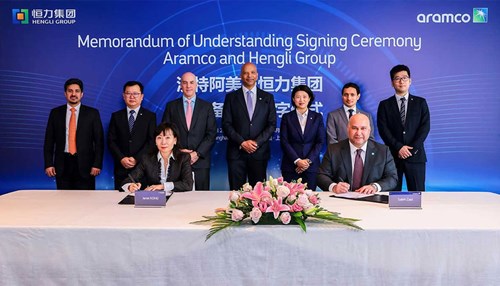
The Project Management Team and New Business Development recently hosted a workshop with representatives from Technical and Vocational Training Corp. (TVTC), the Human Resources Development Fund (HRDF) and the eight main contractors that have been awarded major contracts to build the massive refinery and terminal facilities at Jazan (Jazan Program).

The purpose of the workshop was to align efforts in forming a consortium, as suggested by Saudi Aramco president and CEO Khalid A. Al-Falih during the 2012 contract award ceremony.

The consortium will oversee the training of Saudis to achieve Saudi Aramco’s objectives in the development of the human capital in the Jazan area.

Through the consortium, contractors will receive support from HRDF, TVTC and Saudi Aramco to ensure compliance with Saudization targets stipulated in the associated contracts.

Although contractors are usually responsible for meeting their Saudization targets, this new approach will assist them in reaching these goals.

The consortium will be formed in close coordination with the contractors.

The workforce to build the Jazan Program will exceed 40,000 over the next four years, with an estimated 5,000 Saudi citizens to be hired in the process.

The intent of the workshop was to encourage contractors to sponsor Saudi trainees as early as possible to fill the vocational occupations during the construction phase.

In return, this will have a positive impact in achieving the high Saudization quota set by Saudi Aramco.

Another key outcome sought through the consortium is to provide purpose for the people of Jazan, who should benefit directly from every phase of the program — from the services to be established to the construction activities, and ultimately from the operations of these world-class facilities.

Through its efforts, the consortium plans to make Jazan a magnet for entrepreneurs and investors.

Recruitment will focus on Jazan Province and then expand to neighboring areas as required. A contractor has already hired people from the Jazan area to prepare them for the construction phase.

Such workshops and diligent collaboration thereafter will ensure Saudization targets are met and exceeded every step of the way throughout the program life cycle.

Such efforts, however, go beyond mere contractual obligations and are considered part of Saudi Aramco’s corporate social responsibility efforts.

Several presentations were given, including an overview of Saudi Aramco’s values and how the initiative relates to citizenship, a session on how the training for the Saudi contractors will be conducted to meet international standards, and a strengths, weaknesses, opportunities and threats (SWOT) exercise for contractors to analyze the consortium formation from various perspectives.

First Separation and Filtration forum Held

22 May 2013 | comments (0) | Saudi Aramco News | by

Saudi Aramco News

The Process and Control Systems Department recently conducted the 1st International Separation and Filtration Forum and Exhibit at an al-Khobar area hotel under the theme of “Advanced Solutions to Meet Challenging Requirements.”

The first-of-its-kind event sought to enrich the technical knowledge of Saudi Aramco engineers as well as to share pioneering technologies and exchange experiences and lessons learned with international exhibitors in the oil and gas processing industry.

Filtration is the mechanical or physical operation used for the purpose of separating solids from liquids or gases through a specially designed interposed medium.

These operations are vital to the company to ensure sustaining local and global demand of producing on-specification products.

About 165 people and 10 international exhibitors attended the event, which included two Saudi Aramco exhibitions.

The Research and Development Center demonstrated the Karab (extracted from palm trees) absorption efficiency used for oil spill removal. Also, Haradh Gas Plant illustrated various processes to emphasize the importance of conducting comprehensive analysis for hydrocarbon condensate before installing filtration media.

The event was started with a keynote by Hussain A. Al-Qahtani, manager of P&CSD, who addressed major future challenges.

“With the current increasing international and domestic energy, accompanied by the need to have more complex systems to maintain quality products, developing and using ‘Advanced Solutions to Meet Challenging Requirements’ is paramount to ensure that Saudi Aramco remains a world leader in a competitive business and a major contributor to both the local and global economy,” Al-Qahtani said.

The event focused on vital issues such as enhanced produced water treatment, black powder removal and mercury mitigation through a series of technical presentations in four sessions.

Each session included a panel discussion that provided opportunities for attendees from various Saudi Aramco departments and international vendors to interact with the presenters.

Organizers received positive feedback from those attending the conference. P&CSD’S Upstream Process Engineering Division plans to conduct the event on an annual basis.

Organizers said they plan to improve the event next year by keeping company engineers up-to-date with new technologies and discoveries in the field of filtration and separation.

Also, international oil and gas operators will be invited to attend and share their experiences with Saudi Aramco engineers.

IDiscover Visits Jazan

22 May 2013 | comments (0) | Saudi Aramco News | by

Saudi Aramco News

The southwest corner of the Kingdom pulsed with energy and excitement as hundreds of students and teachers took part in the iDiscover Math and Science Program at the Red Sea city of Jazan.

Organized by the iThra Youth Initiative of Saudi Aramco’s King Abdulaziz Center for World Culture, the program attempts to ignite a spark of creativity in the nation’s younger generation and give them a newfound understanding and appreciation of mathematics and the sciences.

During the first week of the program 200 men and women teachers were trained by 32 men and women “pioneers,” who were selected by the Ministry of Education and Tatweer Education Co. to undergo two weeks of intensive training in the U.S. at the Math Zoom Academy and the Lawrence Hall of Science in California.

Through multiple courses aimed at teaching new methods in science and mathematics, those 200 teachers would in turn teach and train 400 boy and girl students during the second week.

On the second and third floors of the Saudi Elementary School in Jazan, the boys of iDiscover Math and Science Camp had two training sessions daily.

The first session, dedicated to science and math, provided students with methods and tools to help them discover, experiment, compare and apply.

The second session was dedicated to character enrichment, connecting creative minds with others, providing the boys with self-confidence and training on how to express their views and ideas.

In total, the boys spent 100 hours, during which they received intensive interactive learning and training.

The girls spent an equal amount of time dedicated to the same areas at the Second Secondary School over the same time period.

One group of girls submitted an idea to help tourists in Jazan reach popular spots with limited signage, how to avoid getting lost in mountainous areas and how to call for assistance when needed.

Another group of girls suggested replacing rote memorization with discovery and innovation at their school, prompting students to think and do research to reach the learning objective.

Some of the boys presented an idea for design modifications at their school. Another student had an idea for flexible bridges in flood-prone areas in Jazan.

All these ideas reflected boys’ and girls’ overwhelming desire to make their future better and more beautiful through a life full of innovations to be passed on from generation to generation in a society that aspires to spread knowledge, not only on the national level, but to the world as well.

The closing ceremony was attended by the governor of Jazan Area, HRH Prince Mohammed ibn Nasser ibn Abdulaziz Al-Saud, who watched some of the students’ discoveries and dreams that did not stop at a mere presentation.

One of them even promised to build a bridge between Jazan and the Farasan Island, while one female student said she wanted, upon her return to school, to act as a young teacher and convey all that she had learned and discovered to her classmates at school.

This was the fourth stop for the program, having already visited Hayil, Jiddah and Yanbu’.

The program’s last stop will be al-Hasa. At its end, it will have trained 1,000 teachers and 2,000 students from across the Kingdom to look at learning in a new light, and most importantly, to share their newfound knowledge with others.

The Making of Manifa

15 May 2013 | comments (1) | Saudi Aramco News | by

Saudi Aramco News

Unique is a somewhat overused word, but it loses none of its import when attached to the achievement that is Manifa.

The sheer scale of the project is mind boggling. A few numbers set the scene: More than 80 million construction man-hours without a lost-time injury, peak manpower of more than 21,000, 100,000 tons of structural steel, 9,000 km of pipes and cables — the list goes on.

It is the single largest offshore increment in the oil industry and will provide feedstock to two new joint venture refineries in Jubail and Yanbu’.

The story of Manifa begins in 2006 when the task of determining the most effective way to produce from a shallow, offshore oil field had to be undertaken.

The causeway option took prominence as an alternative to 30 offshore platforms that would have required extensive dredging of the area and would have heavily impacted a fragile ecosystem.

In 2008, the first pile of the longest bridge was driven into the seabed and temporary facilities were constructed. In all, 13 bridges were built in a way so as not to impede vital water circulation.

Manifa Department manager Mohammed Abdulkarim isn’t a man at home behind a desk. He’s a man of the field, content when among towering gas oil separation plants (GOSPs) and engineers.

Abdulkarim is passionate about this project that is close to his heart. He has watched Manifa evolve from the draftsman’s drawing board to what some people term an engineering miracle in the oil and gas industry.

While the causeway inevitably steals the limelight, Abdulkarim is keen to point out that the Manifa Project is also a feat of logistics, planning and scheduling. It all came together over seven years and could not have been achieved without quality people, he emphasizes.

The complicated jigsaw was painstakingly joined together piece by piece.

“We looked at alternatives for the causeway design,” Abdulkarim said. “We had to have an onshore field offshore. The conventional way is to dig channels, long channels to connect to deeper sea — something that, in this case, would have proved very expensive and would have had an adverse impact on the environment.”

The natural environment at Manifa Bay is delicately balanced and marked by a rich area of coral reefs resting under its shallow waters, and playing host to a thriving marine habitat.

An extensive scientific study was performed, marking the locations of the coral and sensitive natural areas.

“The study came up with 13 bridges to ensure the proper circulation of the seawater to preserve the natural environment. The longest of the bridges is 2.4 kilometers. That was a part of the challenge we as Saudi Aramco overcame,” he said.

From the project’s outset, emphasis was placed on research designed to avoid potential pitfalls in construction.

“It was like an exercise in reverse engineering. We talked to people involved in projects elsewhere who knew the pitfalls,” Abdulkarim said. “We were dealing with a lot of complex islands in segments and with confined spaces, with the added threat of H2S gas hotspots, which required specialized study and a lot of risk management. Manifa has monitoring devices for this gas, including on vessels in the sea off the causeway.”

Saudi Aramco’s safety contingencies for the gas are detailed and impressive. A control room monitors wind speed, and a digital map has potential hydrogen sulfide (H2S) zones marked with red circles.

Only essential personnel are allowed to work in these areas at any time. Detailed evacuation plans are in place and have been well rehearsed.

The safety of workers is paramount, in line with one of Saudi Aramco’s core values.

All of the contractors were required to meet stringent safety standards, and about 40,000 workers have been trained in H2S awareness.

In 2008, an unforeseen external menace threatened the completion of the Manifa vision. What became known as the Global Financial Crisis played havoc with the fundamentals of the project.

Tenacity — typical of Saudi Aramco — kept the project on track when many outside commentators might have written it off.
Al-Falih told the 2011 World Petroleum Congress in Doha that Saudi Aramco took the long view with Manifa and that an intelligent and economic review of the program with contractors kept the project alive in a torrid global economic climate.

“It was difficult,” he said, “but we stayed with Manifa despite the economic winds blowing around us, and the project is on schedule for a 2013 start-up.”

In the end, Manifa reached the operational phase in record time, and against the odds, it was an achievement for Saudi Aramco and everyone involved.

The King’s Man – Oil and Death

13 May 2013 | comments (2) | Saudi Arabia | by

King Abdul Aziz Al SaudKing Abdul Aziz Al Saud

Never Trust a Man Until He Proves Himself Trustworthy.

So went the philosophy of the mentors who tutored Ibn Saud as a child and it remained his lifelong practice to tryout the integrity of those he would rely on. His friendship with Harry St. John Bridger Philby was strong but Philby was not exempt from the scrutiny of the desert fighter, though Philby never knew or understood this. Over time, his undivided admiration and respect for The King was tested by two key trials, Harry’s desire to convert to Islam and his obsession to cross The Rub al-Khali or Empty Quarter. These were Ibn Saud’s ultimate tests of faithfulness.

Harry challenged the patience of The King with his continual requests to become a Muslim. The flaw in Philby’s brilliant intellect was his lawlessness in expressing his thoughts and his letter to Ibn Saud was no exception to this hot-headed approach. In August 1930 Harry wrote:

Harry PhilbyHarry Philby

Peace. Mercy and the Blessing of Allah be upon you. I have already had the honour to submit to Your Majesty’s consideration my desire to become a Moslem and to abandon other religions…I beg you to accept my conversion to Islam which springs in me from grounds of belief, reflection, wisdom and good intention. Allah the Almighty guides to the right path.

There can never have been a more impertinent letter in the history of Wahhab conversions because Harry Philby intended to do what few others considered; to embrace Wahhabism, not only a religion but a political and economic autocracy.

This time his impudence worked and The King telephoned him personally to say that he would permit the entrance of Philby into Islam and instructed him to leave immediately for Mecca for a ceremony.

On the pilgrim’s trail to Mecca he was met by Fuad Hamza, who advised Ibn Saud on foreign affairs. Hamza set up a tent where Philby performed the ritual ablutions and they continued on their way to Mecca. There, Philby kissed the black stone of the Kaabah and drank from the well of Zamzan before he turned to the east with the holy pledge, “I testify there is no god but God; and that Mohammed is his servant and prophet” – the words inscribed on the first Saudi flag.

Afterwards they went to meet the King in Taif who bestowed on Philby the name Abdullah – Slave of God. More important, the King told the gathered party that Harry Philby was a worthy Muslim and because of his dedication to the Wahhab kingdom would sit with his Privy Council. The King wanted Harry as a dedicated Wahab servant to do his will. The following year, in April 1931, Philby accompanied The King in person on the Hajj, or great pilgrimage, which was a major honour. These devotions helped him on his quest to become Ibn Saud’s grand vizier –an advisor to the throne.

This news caused concern with officials in the British world who knew of Harry’s revolt against the British establishment. The British Consul in Jiddah reported that Philby was at odds with British policy in The Middle East and believed in the restoration of an Arab Empire under a single leader who must be Ibn Saud. The Consul warned that as a member of the Looking Back | The King’s Man 22 Privy Council, Philby was in a position to harm British relations with The King. Moreover, Philby spoke the King’s Nejd dialect, which was scarcely intelligible to other Arabic speakers.

But Ibn Saud was his own man and while he was a true friend and supported Philby, he had particular reasons for Harry’s membership of the Privy Council – Philby had the ears of the mightiest politicians in Britain. The reality was that he was the only conduit in both directions and what information he passed either to The King or British diplomats was one-sided. Ibn Saud understood this and managed the information he allowed Philby to pass to Britain.

The second test of trust by The King concerned Philby’s frustrated ambition to cross The Rub al-Khali or Empty Quarter of Saudi Arabia and it caused the most significant discord in their long relationship. Philby’s lifetime aspiration was to be the first Westerner to explore The Empty Quarter of Saudi Arabia. He cherished the thought that if he succeeded he might be knighted, by the establishment he despised, when he returned to London. To think about a knighthood, he must be first across a wilderness the size of Texas and he needed the permission of Abdul Aziz to make the trip.

Insistent, Philby implored The King for permission to mount his Looking Back | The King’s Man expedition and again and again it was withdrawn at the last minute. Philby was at a loss to understand the motives of The King he admired so much and the final bitter blow came when he learned that a former assistant, Bertram Thomas, had completed the journey in the opposite direction from Salalah to Qatar. He was slightly mollified when the deputy foreign minister, Fuad Hamza told him The King had withheld his consent for so long because of his fear the he might lose Philby’s services that were desperately needed as a counsellor – he feared that Philby might never survive The Empty Quarter. The King’s mind was on oil and he recognised Harry’s value in negotiating a deal that could benefit his country. Diplomatically, Ibn Saud allowed Philby to organise the trip and provided guides, camels, safe passage and paid all the bills.

Harry Philby left Hufuf on 7 January 1932 and by the end of February dignitaries in Jiddah and in London presumed him dead. Two weeks later on March 14, burned black by the sun and totally emaciated he turned up at the oasis of Sulaiy. He had conquered the wilderness but was barely alive. When he recovered, Harry couldn’t wait to travel home to London to receive the plaudits of The Royal Geographical Society, read The Times and watch cricket. As much as he expressed contempt for British society, he enjoyed participating in its activities.

On the 27th of September 1932 Abdul Aziz united the Hejaz and Nejd regions into The Kingdom of Saudi Arabia over which he reigned as King. Early versions of the Kingdom’s dark green flag were decorated with crossed swords under a palm tree and an affirmation in white script “There is no god but God; Mohammed is the prophet of God.”…words that Harry Philby had pledged at Mecca.

In February 1933 negotiations over oil concessions started in earnest with Philby pulling the strings on behalf of The King. Philby knew the limitations imposed on Iraq Petroleum who represented the British interest with a maximum down payment of £10,000. The American interest of Standard Oil offered a down payment of £35,000 if a concession was granted. In addition another payment of £20,000 was payable in eighteen months plus a yearly rental of £35,000. The cards were stacked and Philby even persuaded Andrew Ryan, the first British Minister to Saudi Arabia that it was better to advise the Saudis to accept the American offer because it was most unlikely there was oil there anyway. Also Standard Oil’s shrewd lawyer, Lloyd Hamilton put Philby on an indefinite retainer of 1,000 dollars a month. There could only be one decision and it went in favour of Standard Oil.

Philby achieved the political decision he sought to humiliate the  British and Ibn Saud achieved the commercial decision that would define the future of his Kingdom. Commercial quantities of oil were discovered on the Dammam Dome (Jebel Dhahran) in March 1938. Well number 7 was a deep test well and found biogenic limestone porous enough to hold oil and gas and the taps were turned on.

After hostilities began in World War II, Philby’s disloyal comments about Britain to the Privy Council prompted its other members to comment that he used his words to cover his role as a British spy at court. For the British intelligence services, who were on high alert because of the war, his comments attracted the opposite kind of attention – they might be regarded as treason. Philby’s scornful remarks about Britain alarmed Ibn Saud so much that he told the British authorities of Harry’s intention to travel abroad and spread anti-British propaganda.

Philby was arrested on the 29th July 1940 in Bombay, shipped to England and imprisoned. He remained locked up until February 1941 when he was released as a ‘dotty fanatic’ but his passport was withheld until the end of the war and returned when Ibn Saud asked him back to Jiddah without delay. He sailed to Alexandria and was picked up by Ibn Saud’s private DC3; a present from President Roosevelt. In July 1945, Harry was back in The Privy Council and The King’s Man again.

When Harry was arrested in 1940, oil output was 5.1 million barrels and remained steady through World War II. Extra money came from Great Britain and the USA. To maintain their relationship with Ibn Saud and with Philby’s clever politicking, the British Government granted subsidies that rose to £1m a year. But the major contribution came on 18 February 1943, in the form of Lend-Lease funds of $33m in cash and goods from the USA as well as advances in royalties. As war ended, funds quickly dried up.

Though oil production exploded to 60 million barrels in 1946, the Saudi treasury was still short of income. By 1951 Saudi oil revenue was $110m which included half of Aramco’s profits and in 1952 went past $150m. Harry’s personal fortunes improved in leaps and in 1950 he won a £400,000 contract to build a palace in Riyadh where The King gave him a house. He still maintained contact with the British Secret Service but just to keep them informed of The King’s health which was worsening. When The King died at his palace in Taif in 1953, his body was returned to Riyadh and by Wahabi custom, buried in an unmarked grave. In time, people even forgot where The King was buried but his legacy as a truly great leader was enduring.

In Wahabi tradition, Harry did not grieve for The King but nevertheless reflected for the rest of his own life on their 35 year liaison. Abdul Aziz bin Abdur Rahman bin Faisal al Saud conquered and created his Kingdom by bravery, shrewdness, audacity and the huge force and charm of his personality. These qualities found uniquely in a single human being were why Harry St. John Bridger Philby was, and always would be, The King’s Man.

Editor’s Note:
Mel Trotter lived in Dhahran in the ‘70’s and flew Royal, corporate, Tapline and exploration work. He was a pilot in the Aviation Department – believed to be the first English one where the others were all American at that time with Aramco. A writer and executive coach, he now lives in Wilmslow, Cheshire.
Mel’s latest novel The Orphan Sniper is available in paperback at The Amazon Store and as an eBook on Kindle and compatible devices.

To learn more visit:

Amazon: http://www.amazon.co.uk/Orphan-Sniper-JM-Trotter/dp/1478192925/ref=sr_1_2?s=books&ie=UTF8&qid=1350231509&sr=1-2

Kindle: http://www.amazon.co.uk/The-Orphan-Sniper-ebook/dp/B008AVKSHG/ref=sr_1_1?s=books&ie=UTF8&qid=1350231509&sr=1-1

He can be contacted through his website at www.humanriskfactors.com.

Read The King’s Man – Before Oil.

Reprinted with permission of Mel Trotter.

Aramco Travel Club

Have You Joined?

Learn More
  • Travel around the world with your fellow ExPats.
  • All trips organized through a professional travel agency.
  • Activities like Scuba Diving, RV trips, Skiing, Cruises, and more!

Become a Member Today!